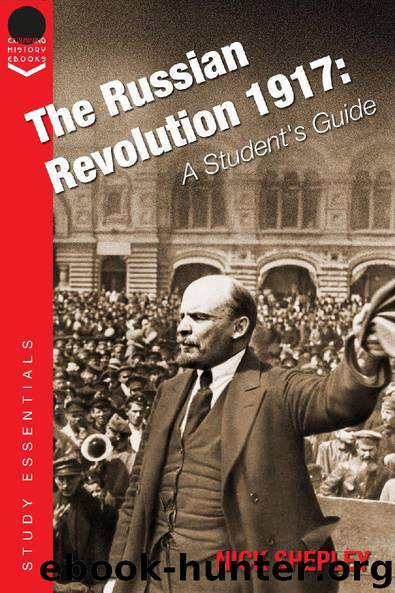
The Russian Revolution 1917 by Nick Shepley
Author:Nick Shepley
Language: eng
Format: epub
Tags: Lenin, Stalin, Tsar, Revolution, Russia, Petrograd Soviet, Provisional Government, February Revolution, October Revolution
ISBN: 9781785385476
Publisher: Andrews UK Limited 2016
Published: 2016-07-11T00:00:00+00:00
Chapter Four: The Revolution in the countryside
The revolution was not contained to Petrograd, it spread into the countryside but it manifested itself in a distinctly different way. Anger and resentment towards the landowners had been building for decades since the perceived failures of emancipation (see chapter one). In the two decades before the revolution many nobles in the countryside perceived a change in attitudes by the peasants. They appeared far less deferential and were sometimes insolent, rude and even threatening. The peasants adopted an ethos of ‘voila’, which roughly translated as a desire to be free from any kind of control. Younger peasants did not see the landowners, the government or any authority, including the village obschina as having any right to control them. Some landowners looked on this development with fear, worrying what might happen if the Tsar’s ability to police the countryside broke down.
In 1917 they found out what would happen, as the peasants, hearing that the Tsar’s government had fallen seized the opportunity this presented. They were anxious for revenge against the landowners, but more importantly, they were hungry for land.
Anarchy
During and immediately after the February Revolution the Russian countryside exploded into violence. Noble families on country estates realised that there was no functioning government to protect them and the rural police (hated by the peasants), slipped away, fearful of what might become of them. Manor houses were burned down and landowners fled, with many escaping to cities such as Moscow and Petrograd. The writer Maxim Gorky, believed that instead of being freed by the revolution, Russia was sliding into a new age of barbarity. Some peasants with a sense of loyalty towards the landowners warned them that peasants on their estates were planning to attack them and they were able to make their escapes. Other landowners, understanding that the revolution had changed everything, decided to offer their land to the peasants voluntarily. When manor houses were attacked it was more common for the contents to be destroyed in anger than stolen. This suggests that the peasants did not see themselves as thieves, the land they took was simply what they believed they were entitled to. Often when they did take property from manor houses, they were practical tools and items such as boots or hunting rifles. The peasants had little interest in the finery of the nobles.
Land
The most important question in peasant Russia was how the land would be divided after the revolution. After the peasants had seized thousands of acres of land, they hoped that a government would come to power that would allow them to keep the land they had taken. Any new government would face considerable difficulties in dealing with the peasants and trying to bring the countryside back under control. It was essential to do this because Russia needed to be fed, wartime inflation had made paper money worthless and the Russian peasants were less and less inclined to take their food to market. Instead they hoarded it, bartered it or consumed
Download
This site does not store any files on its server. We only index and link to content provided by other sites. Please contact the content providers to delete copyright contents if any and email us, we'll remove relevant links or contents immediately.
| Africa | Americas |
| Arctic & Antarctica | Asia |
| Australia & Oceania | Europe |
| Middle East | Russia |
| United States | World |
| Ancient Civilizations | Military |
| Historical Study & Educational Resources |
The Sympathizer by Viet Thanh Nguyen(4440)
The Rape of Nanking by Iris Chang(4255)
World without end by Ken Follett(3510)
Ants Among Elephants by Sujatha Gidla(3494)
Blood and Sand by Alex Von Tunzelmann(3238)
Japanese Design by Patricia J. Graham(3213)
The Queen of Nothing by Holly Black(2656)
City of Djinns: a year in Delhi by William Dalrymple(2580)
India's Ancient Past by R.S. Sharma(2492)
Foreign Devils on the Silk Road: The Search for the Lost Treasures of Central Asia by Peter Hopkirk(2482)
Inglorious Empire by Shashi Tharoor(2462)
Tokyo by Rob Goss(2461)
In Order to Live: A North Korean Girl's Journey to Freedom by Yeonmi Park(2408)
Tokyo Geek's Guide: Manga, Anime, Gaming, Cosplay, Toys, Idols & More - The Ultimate Guide to Japan's Otaku Culture by Simone Gianni(2400)
India's biggest cover-up by Dhar Anuj(2381)
The Great Game: On Secret Service in High Asia by Peter Hopkirk(2371)
Goodbye Madame Butterfly(2276)
Batik by Rudolf Smend(2210)
Living Silence in Burma by Christina Fink(2093)
